It’s 3 pm. Your shoulders are up near your ears, and your neck clicks when you turn it. By the time you log off, a dull headache has settled in behind your eyes. If that sounds like your workday, you’re dealing with what many people call tech neck. A head and shoulder massage Auckland is one of the quickest ways to ease that built-up tension. Below, we explain what tech neck is, how massage helps, what it can’t fix, and how to make the relief last. You’ll also see our prices, session options, and simple desk habits that work between visits.
What Is Tech Neck?
Tech neck is the stiffness and ache that builds up from looking down at screens for hours. It’s not a medical diagnosis, just a handy name for a very common pattern. Your head drifts forward toward the screen, and your shoulders round in to follow it. The muscles at the back of your neck and upper shoulders then work overtime to hold your head up. Over days and weeks, those muscles get tight, tired, and sore. The muscles at the front of your chest get short and tight too. That’s why tech neck feels like a whole upper-body problem, not just a sore neck.
Why Your Head Feels Heavier When You Look Down
Your head weighs about as much as a bowling ball. When it sits straight over your shoulders, your neck carries that weight with little effort. As your head tips forward, the load on your neck grows fast. In a 2014 study, spine surgeon Kenneth Hansraj estimated the force on the neck rises to 12 kg at a 15-degree tilt, 18 kg at 30 degrees, 22 kg at 45 degrees, and 27 kg at 60 degrees. Those numbers are widely shared, so it’s worth being honest about them. They come from a computer model rather than real measurements, and the study’s methods have been criticised, although the overall trend is backed by wider research. The takeaway is simple: the further your head drifts forward, the harder your neck has to work.
Common Signs of Tech Neck
Tech neck tends to creep up slowly, so many people don’t notice it until it hurts. You might find yourself rubbing your neck or rolling your shoulders without thinking. Some people feel it as a burning ache between the shoulder blades. Others mainly notice headaches that start at the base of the skull. If you tick a few of these signs, your desk is likely playing a part. Here’s what to watch for:
- A stiff neck that’s hard to turn, especially in the afternoon
- Tight, raised shoulders that feel heavy
- Headaches that start at the back of the head
- A burning ache between your shoulder blades
- A tight jaw or clenched teeth at your desk
- Tired, strained eyes after long screen sessions
How a Head and Shoulder Massage Helps Tech Neck
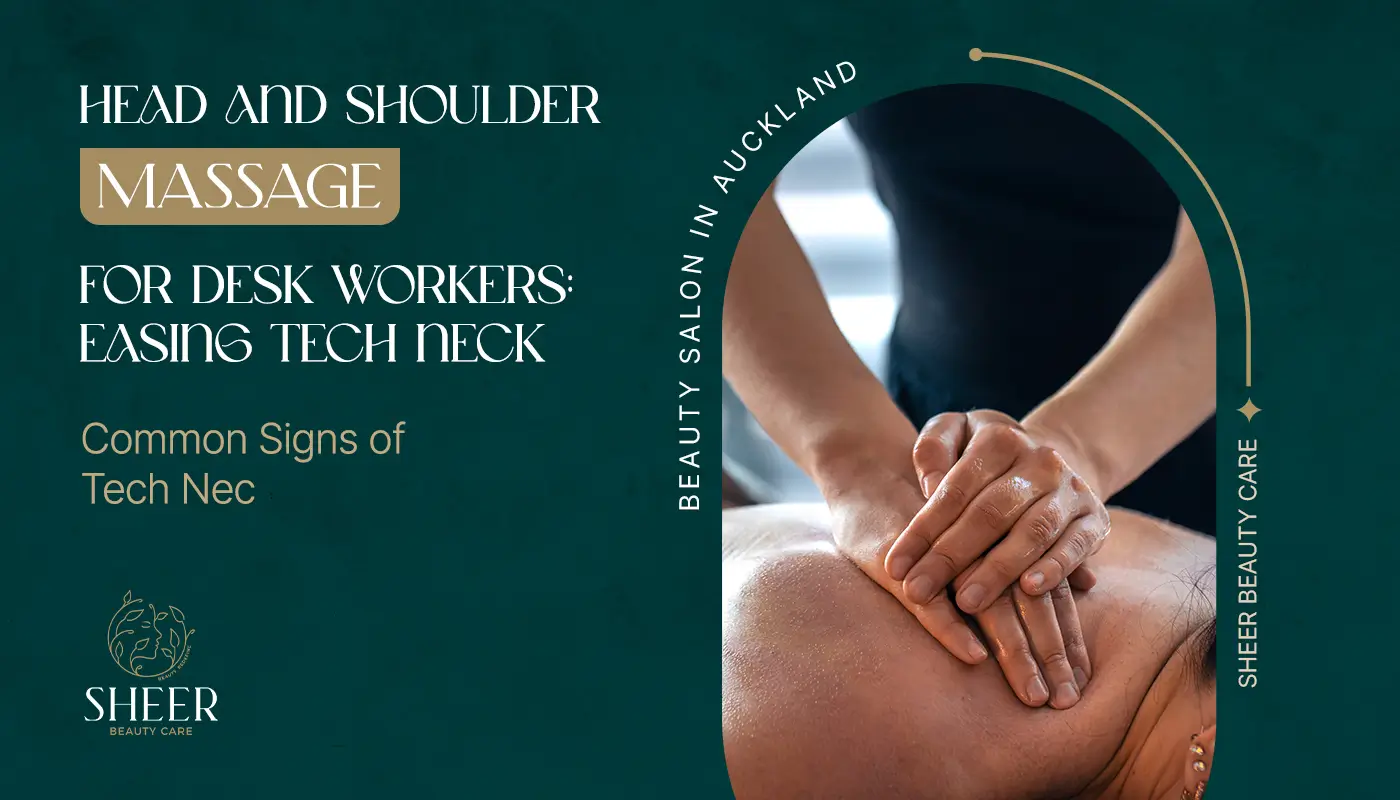
A tech neck massage works on the exact muscles that take the strain at your desk. That includes the trapezius, the levator scapulae, and the small muscles at the base of the skull, all of which tighten from holding the head forward. Slow, firm strokes help those muscles soften and let go. Many people feel they can turn their head more easily after just one session. Scalp work at the end helps ease the tension that often feeds headaches. That’s why a massage for tension headaches caused by desk work so often focuses on the neck, shoulders, and head together.
Research on massage for neck pain has mixed findings. A 2024 Cochrane review found that massage may offer little or no benefit over a simulated massage for persistent neck pain, although the evidence was uncertain. Massage can be part of your relaxation routine, but ongoing pain deserves assessment by a GP or physio.To explore massage beyond desk-related tension, read our guide to the benefits of massage therapy.
What Massage Can’t Fix
We’d rather be honest about what a massage can and can’t do.For local treatment options and prices, see our Albany massage guide. It can’t fix a slipped disc, a pinched nerve, or a joint problem. It also can’t undo eight hours a day at a poorly set-up desk. If your pain is getting worse over time, or it doesn’t ease after a few sessions, please see your GP or a physio. If your neck pain started after an accident, a physio visit may be covered by ACC. Seek medical advice before booking if you have persistent pain, arm tingling, numbness or weakness, or neck pain following an injury.
- Pain, tingling, or numbness that runs down your arm or into your hand
- Weakness in your arms or hands
- Neck pain after a fall, car accident, or sports injury
- Dizziness, fever, or pain that wakes you at night
Seek emergency medical care for a sudden, extremely severe headache, especially with weakness, confusion, difficulty speaking or loss of vision.
What to Expect From a Head and Shoulder Massage Auckland
Our head and shoulder massage takes place in a calm, quiet room at Westfield Albany. We set the mood with gentle music, soft candlelight, and warm massage oil. Before we start, we ask where you feel tension and if you have any injuries or health conditions. Your therapist then works through your shoulders, neck, and head with slow, steady strokes. They’ll check in on pressure, so speak up if you’d like it firmer or softer. Most people feel a mix of relief and mild tenderness in the tightest spots. By the end, your shoulders should feel lower, looser, and lighter.
Here’s how a typical session flows:
- Quick check-in about your tension spots, injuries, and pressure preference
- Shoulder work to loosen the tight band across your upper back
- Neck work along the sides and back of the neck
- Base of the skull to ease the spots that feed tension headaches
- Scalp massage to finish with a calm, light feeling



30 or 45 Minutes? Prices and Options
Choosing the right length makes a real difference to your results. Our Head, Shoulder Massage is $60 for 30 minutes or $90 for 45 minutes. The 30-minute session suits a lunch break and a quick reset. The 45-minute session gives your therapist more time on stubborn knots and the base of your skull. If your tension runs down your back as well, a full body massage may suit you better. We also offer a short Head Massage for $40, and a Full Body Relaxing Massage at $85 for 45 minutes or $125 for 60 minutes. Here’s how our options compare for desk-related tension:
| Massage | Time | Price | Best For |
|---|---|---|---|
| Head Massage | Short session | $40 | Screen-tired eyes, scalp tension, a quick break |
| Head, Shoulder Massage | 30 min | $60 | Lunchtime reset for tight shoulders and neck |
| Head, Shoulder Massage | 45 min | $90 | Stubborn knots, tension headaches, a deeper reset |
| Full Body Relaxing Massage | 45 min | $85 | Tension that spreads into the back and arms |
| Full Body Relaxing Massage | 60 min | $125 | Long-standing tightness and overall stress |
How Often Should Desk Workers Book a Massage?
The right rhythm depends on how long you’ve had the tension. For general relaxation and stress relief, many people benefit from a massage every 2 to 4 weeks. That works well for everyday stiffness that builds up over a busy month. Long-term neck pain is a different story, and the research is clear about it. In a trial of 228 people with chronic neck pain, multiple 60-minute massages per week worked better than fewer or shorter sessions after four weeks. In that study, 30-minute sessions didn’t beat the waiting list for meaningful improvement, no matter how often they were given. So if your neck pain has lasted months, a short session is a nice reset, but longer sessions and a physio plan will likely help more.
Here’s a simple way to plan your bookings. For everyday desk stiffness, a 30 or 45-minute neck and shoulder massage Albany workers can fit in after hours every 2 to 4 weeks is a good start. For pain that’s been building for months, choose longer sessions closer together for a few weeks, then space them out. Pair that with a physio check if the pain doesn’t ease. Track how you feel the day after each session, so you know what rhythm works for you. Your therapist can help you adjust the plan as you go. The goal is fewer bad days, not a perfect neck.
Desk Habits That Make Your Massage Last
A massage loosens tight muscles, but your desk can tighten them right back up. Small daily changes help protect the relief you’ve paid for. You don’t need fancy gear or a new chair to start. Most fixes take a few minutes and cost nothing. Pick one or two habits this week, then add more once they stick. Notice which changes help you feel more comfortable during the workday. Here’s where we’d start:
- Raise your screen. The top of your monitor should sit at or just below eye level, about an arm’s length away.
- Lift your laptop. Use a stand or a pile of books, plus a separate keyboard and mouse.
- Bring your phone up. Hold it closer to eye level instead of dropping your head to your lap.
- Move every 30 minutes. Stand up, roll your shoulders, and walk to get a glass of water.
- Rest your eyes. Follow the 20-20-20 rule: every 20 minutes, look at something 20 feet (6 metres) away for 20 seconds.
- Do quick stretches. Try gentle chin tucks, slow shoulder rolls, and a doorway chest stretch a few times a day.
Bringing Massage to Your Workplace
If your whole team sits at desks all day, tech neck is probably a shared problem. Many workplaces now offer on-site massage as a wellness perk. It’s a simple way to show staff you care, and it fits easily into a workday. We offer an Employee Wellness service that brings massage to your workplace or event. Short sessions can run back to back, so more people get a turn. It also works well for team days, milestones, or a thank-you after a busy quarter. If you’re looking for workplace massage Auckland teams can enjoy, get in touch to talk through options.
Head and Shoulder Massage FAQs
Does a head and shoulder massage help tech neck?
Yes, for most people it eases the tight, tired muscles behind tech neck. You’ll often notice easier head movement and lighter shoulders right after a session. For lasting change, pair your massage with desk habits and regular movement.
Will a massage help my tension headaches?
It often helps headaches that start in the neck and base of the skull. Easing those tight muscles can reduce how often and how strongly the headaches come. If your headaches are sudden, severe, or come with other symptoms, see your GP first.
Should I choose 30 or 45 minutes?
Choose 30 minutes for a quick reset during a lunch break. Choose 45 minutes if you have stubborn knots, regular headaches, or tension that’s been building for weeks. If your tension spreads into your back, a full body massage may suit you better.
Will I be sore after a head and shoulder massage?
You may feel mild tenderness in the tightest spots for a day or so. That’s normal, and it usually feels like the ache after a good workout. Drink water, move gently, and tell your therapist next time if the pressure felt too firm.
Can I book a head massage in Auckland after work?
Yes. Sheer Beauty Care at Westfield Albany is open until 9 pm on Thursdays and Fridays, and we’re also open on weekends. You can book a head massage Auckland after work on Thursdays or Fridays, or choose a weekend appointment.
Ease Your Tech Neck With a Head and Shoulder Massage in Auckland
Tech neck builds slowly, but you don’t have to live with it. A head and shoulder massage loosens the muscles that take the strain at your desk, and it often eases tension headaches too. Massage works best as part of a plan, with better screen height, regular breaks, and simple stretches. For long-standing pain, longer sessions and a physio check will likely do more than a short session alone. Watch for red flags like arm numbness or severe headaches, and get checked if they appear. When you’re ready for some relief, we’re right here at Westfield Albany. Book online, call 09 220 7002, or WhatsApp 022 454 1008 to book your head and shoulder massage.